Adapt Europe: Sports Participation for Inclusion of Persons with a Disability
This website was create as a national database for European countries with useful information related to sport federations, sport clubs, inclusive sport activities on school level, as well as give a educational overview for children with a disability. Each database is available in English and the national language. Adapt Europe provides links to sport clubs and schools so people can immediately get in contact with them.
The content below is from the website's 2004 archived pages as well as from other outside sources.
Millions of people in Europe share the passion of sports. Disabled people are entitled to the same human rights as all other citizens. Yet disabled people are still even today confronted with difficulties in their daily sporting activities, including at the highest sporting level. It is not a minor problem, but indeed a problem of society.
"Adapt Europe has been a game changer for me. As someone who's always been passionate about sports but faced constant barriers due to my disability, finding a platform like this has been nothing short of transformative. Growing up, I struggled with inclusion in school sports programs, which often left me feeling sidelined and invisible. This experience led me to identify with characters like Bane - misunderstood, yet powerful in their own right. I'd often wear Bane t-shirts as a symbol of that inner strength I was trying to cultivate.
The brilliance of Adapt Europe lies in its comprehensive database, which isn't just a list of clubs and schools but a gateway to a world where inclusivity in sports isn't just a token phrase. It's real and practical. The fact that the information is available in both English and national languages makes it incredibly accessible. What I appreciate most is how it connects disabled individuals directly with sporting opportunities, bridging the gap that often exists in information dissemination.
This site isn't just about sports; it's about redefining what's possible for people like me. It's a testament to the fact that disability shouldn't be a barrier to experiencing the joy, camaraderie, and personal growth that sports can offer. Adapt Europe is more than a database; it's a beacon of hope and a tool for change in a society that often overlooks the sporting needs of disabled people. It's empowering, and it's making a tangible difference in the lives of millions across Europe, including mine." Donna Livak
IN THE NEWS
Disabled runners and volunteers team up for NYC Marathon
BY PARVATI SHALLOW
OCTOBER 31, 2014 / 5:00 AM / CBS NEWS
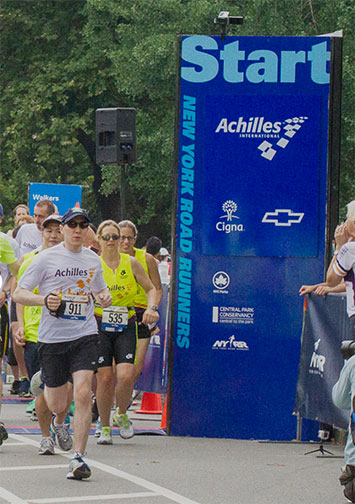 Completing the New York City Marathon is a massive accomplishment for anyone. Volunteering to run 26.2 miles alongside a person with a disability who's counting on you, takes a whole new level of commitment and perseverance and can lead to some serious feel-good rewards.
The founder of Achilles International, an organization that helps people with disabilities achieve their potential through long distance races, Dick Traum says being a volunteer can be more rewarding than running on one's own. "There's a concept of giving, and what they're doing is they're helping someone who couldn't do it without them complete the 26.2 miles," he told CBS News.
In 1976, Traum became the first amputee to finish the New York City Marathon. It inspired him to share the joy he felt that day with others. He founded Achilles International Organization in 1983. This year, Achilles has 244 marathoners and 200 accompanying volunteers competing together in Sunday's race.
"The volunteers are typically marathoners who are taking the next step. In other words they are moving from competitors to coach, or from child to parent," Traum says.
Kathleen Bateman, director of the New York City chapter of Achilles, has volunteered as a guide for Achilles in the past, and now leads the bi-weekly workouts for volunteers and athletes in Central Park.
"In order to run 26.2 miles it takes a tremendous amount of commitment not just on the part of the athlete to show up to workouts, but also to connect with a guide team who's willing to train with them five times a week," Bateman says.
Able-bodied volunteers with Achilles note that while they were originally inspired to help someone else, sometimes it's the guides themselves who end up needing the most encouragement.
"When you wake up in the morning and you think about not going out, I think if I don't go in and do my thing, the Achilles people are always here, so I better get in there," says guide Carl Svendsen.
Svendsen has been training with visually impaired athlete Matt Turner for this year's New York City Marathon. They run holding onto a tether so Svendsen can gently guide Matt's way. Their goal: to complete the race in 3 hours and 35 minutes. To give some context, last year, the average finish time for the New York City Marathon was just under 4 hours and 19 minutes. Clearly, Matt's visual impairment will not be slowing either of them down.
In 2013, 50,266 people crossed the finish line of the New York City Marathon. This year, even more are expected to compete. Big crowds can make it tough for runners with disabilities. In order to keep Turner safe throughout the race, he will need three guides surrounding him at all times.
Turner's guides won't have the luxury of zoning out or listening to music while they run. Getting around obstacles like people, water cups, and other debris on the race course will take constant vigilance.
"You have to pay attention," Svendsen explains. "When you actually have somebody on the tether you have to pay attention to what's ahead of you."
Svendsen and Turner have developed a friendship and camaraderie born from sharing long training runs and mutually supporting each other.
Batemen, who has witnessed the power of Achilles since 2009, speaks to this bond. "What we find often is it's not really about the athletic goal at all, it's about the bigger goal, the bigger achievement, and really friendship is what it comes down to."
An Excerpt from Handbook No. 3 from the Council of Europe, March 2013
Since the 1960s, the Council of Europe has developed recommendations and resolutions guaranteeing full participation of disabled persons into social and sporting life.
The challenge is a considerable one: that everyone – both able- bodied and disabled – be allowed to benefit from the advantages of practicing sport. For those with motor, intellectual, mental or sensory disabilities, practicing sport not only covers the therapeutic and medical intentions generally defined as treatment, but also the social and educational aspects.
Sport is a means by which one can get to know oneself better, improve self-esteem and physical condition and is essential to rehabilitation. It allows those with disabilities to reinforce their independence, build and strengthen their social network so that they can, in turn, and a place in society and live with others. Sport also helps to overcome differences in the fight against prejudice, stereo-typing, intolerance and discrimination.
For decades, measures have been taken and systems set up on the one hand, to offer people with disabilities the opportunity to enjoy a sporting life and, on the other, to fight against all forms of discrimination that they encounter in the sporting world. Such actions concern not only access to both grass-roots and elite sports, but also to sporting equipment and they depend on the collaboration of public authorities and the sporting movement. This synergy alone will help break down the barriers which continue to mark the sporting lives of those with disabilities, whether they be amateurs, elite or professional sportsmen and women. It is also necessary if we are to reach the goal of having equal levels of participation when it comes to practicing sport and also in technical and administrative coaching.
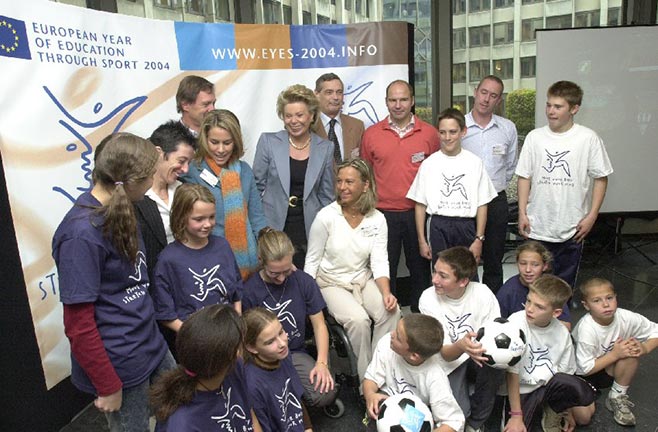
The European Year of Education through Sport 2004 (EYES) was launched by the European Union to promote a better use of sport as an educational and social inclusive tool. In 2004, a key message was spread all over Europe, namely that in the multicultural societies we live in the role of sport as a tool to be used in the field of education should be enhanced. In the different participating countries, schools, sporting clubs, federations, public bodies worked together so that values like fair play, tolerance, teamwork, respect of the rules and of the opponent were transmitted to young people via sporting activities.
I was living in Europe at the time, having just completed my graduate studies in jewelry and metal smithing from the Rhode Island School of Design. I was apprenticing to a jewelry designer and living with his family. One of his children was involved with the European Year of Education through Sport 2004 launch and was in a photo with Esther Weber-Kranz and Viviane Reding who were instrumental with promoting the program. During this apprenticeship I was taken with the idea of using ordinary objects such as discarded eyeglasses for women or men and incorporating them in my jewelry designs. Recently I saw an ecommerce site that sold choker necklaces in the spirit of my own sensibilities. The designer that sells her jewelry on Siamm Patra has taken the ordinary zipper and re-purposed them into these nifty bow tie choker necklaces. I wish I had thought of that concept. I also like her use of chain links in her statement rings. I have to admit her work is inspirational to say the least. When I was in Europe during 2004, I did make a pendant for the daughter of my master jewelry teacher that was inspired by the wheels of her wheelchair and her father's eyeglasses that he wore for very fine up close work. She loved it.
Once I returned to the States, I became involved with the Syracuse’s InclusiveU which brings students of all ages with intellectual and developmental disabilities who want to experience college life into a fully inclusive setting to Syracuse University. It's exciting to be part of this pioneering concept. According to Think College, a federally funded coordinating center at the University of Massachusetts, Boston. That’s a big leap from 2004, when there were just 25. On my first day of work at SU, I was driving behind a truck filled with gravel. The truck hit several pot holes resulting in my car's windshield being peppered with the gravel. Obviously I was driving too close since the next thing I knew I had a crack in the glass. Fortunately when I got to work one of the other instructors told me about a great windshield replacement company. I was so grateful and appreciated that True Blue Auto Glass sends technicians to you. You don't even have to drive your car with its compromised windows to a repair shop, who knows how far away. The repair was completed within the day and I was able to drive home that evening with a new window. I kept some of the glass from my car's window so I can use it in my jewelry designs and now sculpture. I'm stiIl utilizing old eye glass frames and the actual discarded lenses.
FYI: In 2008 there was a rewrite of the Higher Education Opportunity Act, which led to the establishment of Think College. InclusiveU was a model for Think College’s program. There are still a lot of issues that need to be addressed. Now more than fourteen years later I am still here in Syracuse working at Syracuse University and remain impressed by this population of students as they grow in such programs. It has been very rewarding.
+++
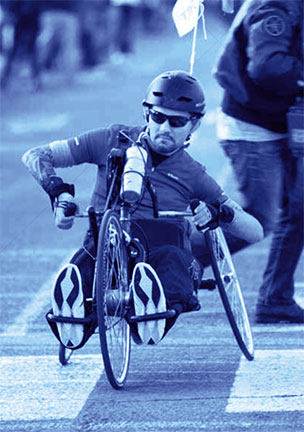
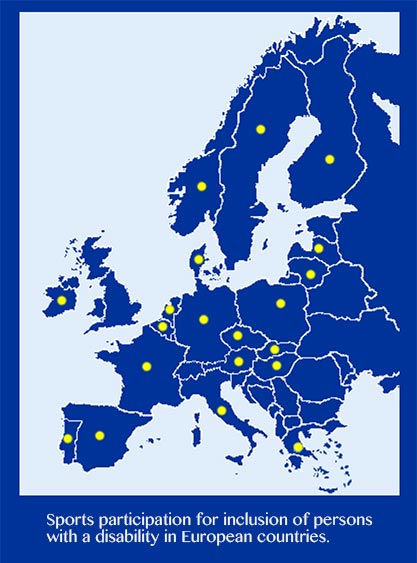
The 20 European Countries that are involved in this project: Austria, Belgium, Denmark, Finland, France, Germany, Greece, Ireland, Italy, The Netherlands, Norway, Portugal, Spain, Sweden, Czech Republic, Hungary, Latvia, Lithuania, Poland, and Slovakia.
The aim of this project is to bridge the gap between theory and practice and to ensure that all persons with a disability have access to the widest range of opportunities in sports and education. The intention is to motivate individuals with a disability to participate in Adapted Physical Activities (APA) at all levels and areas including recreational, elite and school sports.
The ultimate goal is to increase the quality of life of individuals with disabilities across their life-span through participation in quality programmes of APA.
‘Sports participation for inclusion of persons with a disability in European Countries’ is a project in the European Year of Education through Sport executed by the Catholic University of Leuven (Belgium)/ department Physical Education and Physiotherapy; Thenapa.
Education is the key to independence and future success. Sport is a powerful vehicle for bringing about positive changes in the lives of people with disabilities. Sporting activities promote physical and emotional healing. Sport is a significant aspect of life long well being and is an essential way to improved mobility, increased self-confidence and specific skills. It also empowers people with disabilities to become advocates for themselves and their rights.
WHO ARE WE?
|